Bali Vegan Product Brands: What Is Actually Made Here
Search for vegan products in Bali and you get a shelf, not an answer. Retail category pages return ninety-eight results, restaurant lists return a hundred cafés, and neither tells you which of those products was made on the island and which one crossed an ocean to get here.
This piece does the split. It maps six product categories by where they are actually produced, gives you five questions that separate a Bali producer from a repackager, and shows what a vegan label still hides. If you only want the milk aisle, the plant milk brands guide already covers that ground in detail.
Why the shelf is a poor guide to what is local
A Bali health food aisle mixes three different things under one label. There is the independent producer with a kitchen in Ubud or Canggu, and there is the retailer’s own kitchen, which cooks in-house and brands the result with the shop’s name. Then there is the imported carton, which may carry a local distributor sticker and nothing else.
Vegan is a formulation claim, not an origin claim. It says nothing about where the cashews grew, how far the bottle travelled, or whether the cheese was cultured in Gianyar or shipped frozen from Europe.
The economics explain the pattern. Indonesia harvests roughly 164,000 tonnes of cashews a year, around sixth in the world according to World Population Review, and most of that crop still leaves the country as raw nut rather than finished food. A country that grows the raw material and exports it has a structural reason to import the finished product.
The category map: what Bali actually makes
Six categories cover most of what a vegan shopper buys in a week. Start here if you are standing in a shop with your phone out.
| Category | Made on the island at real scale? | What local looks like | What to check on the label |
|---|---|---|---|
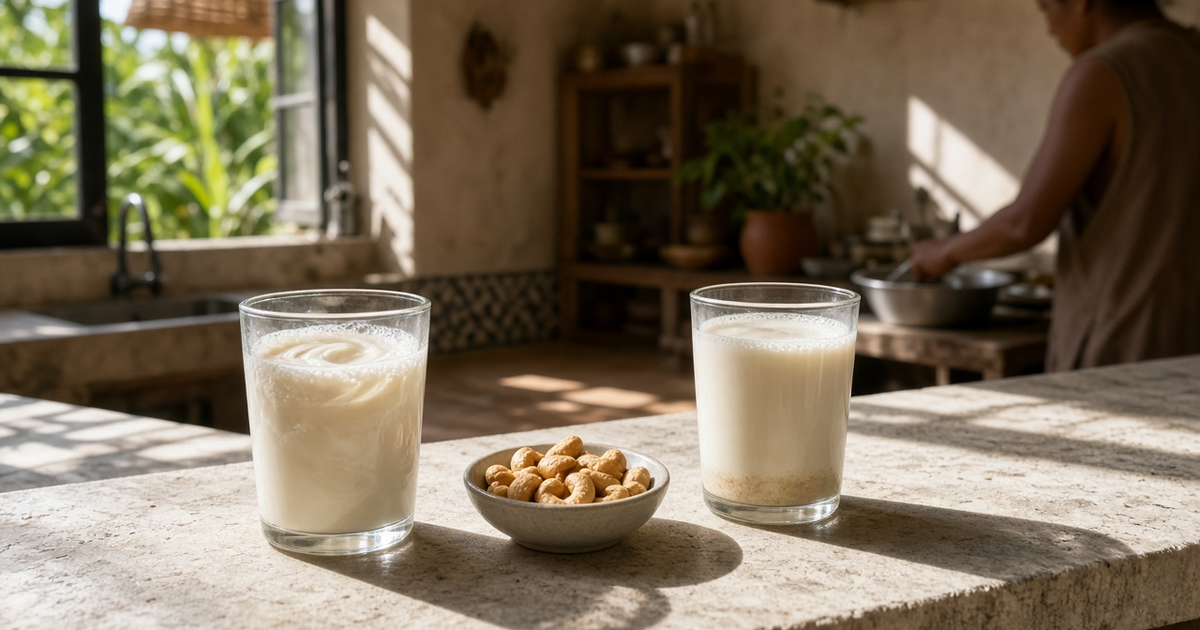
| Fresh plant milk | Yes, small-batch | Chilled bottle, short list, weeks of shelf life | Production date in days, not months |
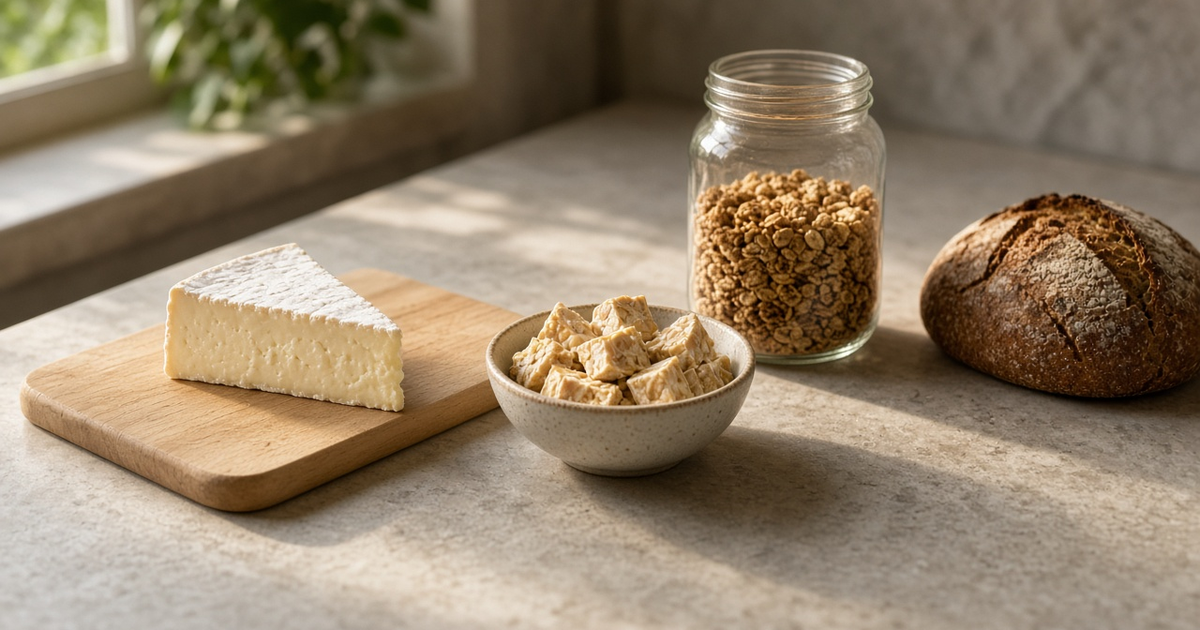
| Tempeh and tofu | Yes, the oldest category here | Wet market or producer wrap, fermented | Same-day or next-day date, no preservatives |
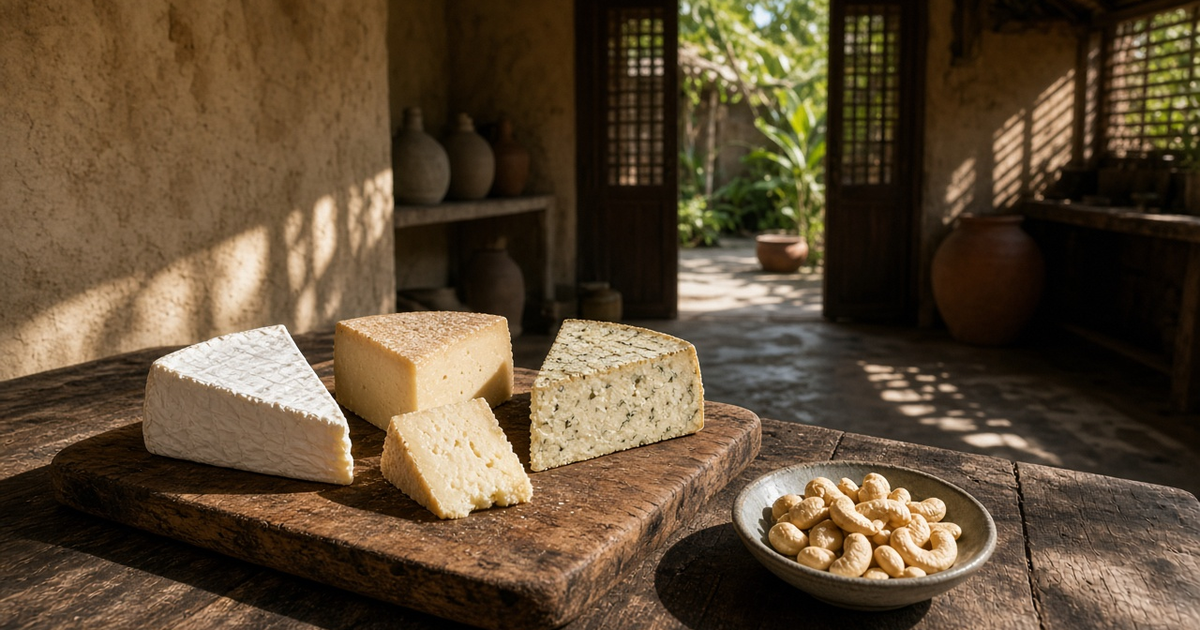
| Cultured alternatives (cheese, butter, yogurt) | Yes, young scene | Named kitchen, cultures listed, chilled | Nut base, cultures, gums, oil type |
| Granola, snacks, chocolate | Yes, partly | Small-batch bag, Bali cacao or local fruit | Added sugar per serving, oil type |
| Condiments and pantry | Yes, mostly | Sambal, salt, coconut sugar, vanilla | Single ingredient or close to it |
| Bread and pastry | Yes, widely | Baked daily, sold from the shop | Whether the “vegan” claim covers eggs and dairy |
Categories that spoil fast and weigh a lot are made here, because freight and cold chain make imports expensive and slow. Categories built on a raw material that does not grow here, almonds and oats being the obvious two, stay imported.
The categories where a local producer genuinely wins
Fresh milk and cultured alternatives
Fresh plant milk, cultured cashew cheese, coconut yogurt and vegan butter all exist locally now, made in kitchens small enough that the person answering WhatsApp knows the batch number.
TreeNut Cheezery has cultured cashew and pili-nut cheeses in Ubud since 2019, sources its cashews from a social enterprise in Muntigunung in north-east Bali, and delivers chilled. Bali Buda makes a vegan butter from coconut oil, cashew, olive oil, Bali sea salt, water and turmeric, and a coconut yogurt from coconut cream and a brown rice culture. Both publish their ingredient lists, which is the only reason either example belongs in an article like this.
A fresh local product loses on shelf life and wins on the label. That trade is real and it is the whole argument.
Tempeh and tofu
Tempeh is not a health food import. It is an Indonesian staple that happens to be vegan by default, made from whole soybeans and a mould culture, wrapped in banana leaf or plastic and sold within a day or two. Tofu follows the same logic.
Because the category is old, it is also cheap, and cheap categories attract the least label scrutiny. The check here is the date, not the ingredient list. Fresh tempeh has a date measured in hours.
Granola, snacks and chocolate
Bali has real cacao, real fruit, and a tourist economy that supports small-batch production. Granola, energy bars, chocolate and dried fruit snacks are made here in volume, often by kitchens attached to a café or a retail brand.
A retailer can buy imported oats, bake them in Canggu, and the result is legitimately made in Bali while the raw material is not. That is not a scandal, but it changes what the word means.
Condiments, salt and sugar
The shortest ingredient lists on the island sit here. Kusamba sea salt is harvested on Bali’s east coast, coconut sugar comes from Central Java, and vanilla is grown and extracted locally. Sambal and chili crisp are made in home-scale kitchens and sold in jars.
If you want to test whether a shop is serious about local sourcing, start in this aisle. A shop that carries local salt and local vanilla probably knows its suppliers.
Where the imported carton still wins, honestly
Local does not mean better in every category, and pretending otherwise is how a list like this loses its credibility.
- Almonds and oats: neither grows here at commercial scale. An almond milk made in Bali is made from imported nuts, which is fine, but the “made in Bali” line is doing less work than it appears to.
- Shelf-stable cartons: if you need milk that survives a week in a villa fridge that loses power, the UHT carton is the correct purchase. Fresh milk needs an unbroken cold chain.
- Price per litre: imported cartons undercut local bottles. The cost breakdown for plant milk in Bali explains where the gap comes from, and it is mostly cold chain and batch size.
The honest version of buying local is that you pay more for a shorter chain and a shorter ingredient list. You do not get a superior nutrient profile. No plant milk matches dairy on protein or calcium unless it is fortified, and most fresh local bottles are not.
Five questions that separate a producer from a repackager
This is the part you can run in ninety seconds, in a shop, without being rude about it.
- Where was it made, and where was it packed? Those are two different sentences. A product packed in Denpasar from imported paste is assembly. A product made in Ubud from cashews milled on site is production. Both may say Bali on the front.
- What is the address on the label? A producer address is a kitchen or a workshop. A distributor address is an office. Neither is a crime, but only one of them can answer a question about the batch.
- What unit is the date in? Days means fresh and refrigerated. Months means the product was built to endure. The unit tells you more about processing than any marketing line on the front.
- Where did the main ingredient grow? A producer close to its supply names regions without hesitating: Sulawesi, Nusa Tenggara, Muntigunung, Central Java. An evasive answer is data too.
- What happens between the kitchen and your fridge? Chilled delivery, an ice pack, a stated delivery window. A fresh product with no cold chain story is a fresh product that will not arrive fresh.
The tell is never a single answer. It is whether the answers line up with the format. A three-week refrigerated bottle and a two-month ambient jar cannot both be the same kind of business.
What a vegan label still does not tell you
Vegan certification answers one question: no animal ingredients. It does not answer the questions a clean-label shopper actually has. A product can be vegan and still carry four gums, a refined oil, and 12 grams of added sugar per serving.
| On the label | What it means | What it does not mean |
|---|---|---|
| “Vegan” | No animal-derived ingredients | Nothing about additives, sugar or origin |
| Xanthan, gellan, carrageenan | Texture and suspension, so the product does not separate | Not a safety problem, but a sign the base needs help |
| Sunflower lecithin | A plant emulsifier from sunflower seeds | Not the same thing as sunflower oil |
| “Natural flavour” | A flavour compound from a plant or fermentation source | Not a disclosure of what it is |
| Coconut sugar | A sugar with a lower glycaemic index than white sugar | Still sugar, and still counted |
The allergen line matters as much as the ingredient line. TreeNut states plainly that all of its products contain nuts, because a cashew cheese is still a cashew product. Vegan does not mean allergen-free, and the two get confused constantly.
If you are managing a diagnosed allergy, that is a conversation for your clinician and the producer, not for a blog post.
This article is general information, not medical advice. If you have a diagnosed condition, are pregnant, or are changing a child’s diet, talk to your doctor or a dietitian first.
How to choose between the two shelves
Choose a local producer if:
You cook at home most days, you have fridge space, you shop weekly rather than monthly, and you care more about a six-ingredient list than about a price per litre. You also get a supply chain short enough to ask questions about, which is the actual product being sold.
Choose the imported carton if:
You need the product to sit in a cupboard for two months, you are stocking a rental villa, or the specific item you want does not grow here and has no local maker yet. Oat milk is the clearest case: the oats are imported either way, so the local premium buys you freshness, not origin.
Choose neither if:
You are buying the product for a nutrient you have not checked. Any unfortified plant milk is a weak source of calcium and vitamin D compared with dairy, and no amount of local sourcing changes that arithmetic.
Where the local list actually sits on a shelf
Knowing a product exists is not the same as finding it.
- Bali Buda outlets: the long-running health food chain, with its own kitchen making yogurt, butter and baked goods, and shelves carrying other local producers.
- Bali Direct in Canggu: an online whole foods store with an in-house kitchen, so some of what it sells under its own name is made locally and some is bought in. Read which is which.
- Bali Food Store: a multi-brand grocery that groups small local producers under one delivery, useful when you want one order rather than five WhatsApp threads.
- Ubud markets and farm gates: the cheapest route to tempeh, tofu and produce, and the only route where you can ask the maker directly.
- Direct from the producer: the norm for fresh, chilled goods. Delivery is arranged over WhatsApp, and the batch is usually made after you order, not before.
Fresh local products sit in a chiller, never on an ambient shelf, so shop the refrigerated case first.
Where Worry Nut fits on that map
Worry Nut is a fresh cashew mylk made in Ubud, in small batches, and sold chilled. It belongs to the category that spoils, which is why it is bottled in opaque food-grade HDPE instead of glass and delivered cold rather than shipped ambient.
The formulation is six ingredients in a fixed order: filtered water, Indonesian cashews, Central Java coconut sugar, Kusamba sea salt, sunflower lecithin, and Bali vanilla. No gums, no refined seed oils, no preservatives. It is pasteurised gently rather than UHT treated, which is why it holds for 21 days unopened in the fridge at 1-4 °C and is best finished within four days of opening.
Shake before pouring. Without stabilisers it separates, and that is the expected behaviour rather than a fault.
Per 200 ml serving, measured by Prodia OHI: 80 kcal, 6 g fat, 5 g carbohydrate, 2 g sugar, 2 g protein, 150 mg sodium.
Cashew milk is not a nutritional substitute for cow’s milk. Worry Nut carries 2 g of protein per 200 ml serving against roughly 8 g in cow’s milk, and it is not fortified with calcium or vitamin D. If you are relying on milk for those nutrients, plan for them elsewhere.
Cashew is a tree nut, so this bottle is not for anyone with a tree nut allergy. If you are avoiding dairy for a diagnosed reason rather than a preference, the difference between dairy allergy and lactose intolerance is the article to read before you shop, and the label-reading guide is the one to read in the aisle.
Delivery runs cold in Bali: Canggu, Ubud and Seminyak, or anywhere in the served Bali area on an order of three bottles or more. Bali orders go straight through the order page, same day if you order before 14:50 WITA. Jabodetabek is unaffected and goes through the local stockist.
If you want the wider economic argument for short-chain food on this island, why buying local plant milk matters covers it.