Plant Milk for IBS: What to Look For on an Indonesian Label
Plant milk for IBS is a label decision before it is a milk decision. The FODMAP content of a carton depends on the base, the serve size, and three lines near the bottom of the ingredient list, and on an Indonesian shelf those three lines are usually where the problem sits. Almond and rice milk pass at a full cup, oat milk does not pass at latte size, and cashew milk is the entry the lab data has not settled.
This article runs that lens across the formats sold in Bali and Jakarta, gives the tested serve sizes, and says plainly where the evidence stops. It is a shopping guide, not a symptom plan.
This article is general information, not medical advice. If you have a diagnosed condition, are pregnant, or are changing a child’s diet, talk to your doctor or a dietitian first.
What the FODMAP lens actually measures
FODMAP stands for fermentable oligosaccharides, disaccharides, monosaccharides and polyols. In practice it is a short list of carbohydrates that some guts ferment quickly, drawing water in and producing gas. The diet was developed at Monash University as a clinical protocol with an elimination and a reintroduction phase, not a permanent way of eating.
For milk, only four of those carbohydrate families matter:
- Lactose: the sugar in cow’s milk, and the reason regular dairy is high FODMAP at a normal pour.
- GOS: galacto-oligosaccharides, the legume carbohydrate that makes soy milk from whole beans a problem.
- Fructans: the chain carbohydrates in oats, wheat, onion, and in added fibres such as inulin and chicory root.
- Sorbitol: the polyol that shows up in coconut milk at larger serves.
Fat and protein are not FODMAPs. Carton marketing sells texture, and texture is a fat and gum story. A milk can be thick, creamy and irrelevant to the question you are asking.
The tested serve sizes
Monash publishes low FODMAP serving sizes for the plant milks it has tested, and the spread is wide enough that “plant milk” as a category tells you nothing. The numbers below come from the Monash FODMAP programme and from a dietitian’s summary of the tested values.
| Base | Low FODMAP serve | What tips it over |
|---|---|---|
| Soy, from soy protein | 257 ml | Nothing at a normal serve |
| Almond | 240 ml | Added inulin or chicory root |
| Rice | 200 ml | Larger serves, brand dependent |
| Macadamia | 240 ml | Rarely sold in Indonesia |
| Coconut, unsweetened | 180 ml | Sorbitol above that |
| Oat | 140 ml | GOS and fructans above that |
| Hemp | 120 ml | Fructans above that |
| Soy, from whole beans | 30 ml | GOS and fructans, so a splash only |
Read the oat row twice. A 140 ml low FODMAP serve is smaller than a small latte, and oat is the base most Indonesian cafes pour by default. Someone who switched from dairy to oat for gut reasons may have moved from a 20 ml lactose threshold to a 140 ml fructan threshold: an improvement, not a free pass.
The soy row is the other one worth understanding. Whole soybeans carry GOS into the liquid, so the milk is high FODMAP at almost any drinking serve. Soy protein isolate has that carbohydrate removed in processing, which is why the same plant produces a 257 ml serve. The difference is on the label, not in the flavour.
Reading an Indonesian carton
Imported UHT cartons dominate the Bali and Jakarta shelf, and they are built for a year of ambient storage. That usually means a sweetener, a stabiliser and sometimes an added fibre, and each can move the FODMAP maths. Work through three lines in this order.
- Find the base line. “Susu kedelai” or “soybean” means whole beans. “Protein kedelai”, “soy protein” or “soy protein isolate” means the low FODMAP version. This single line changes the serve size by a factor of eight.
- Find the sweetener. Plain sucrose and coconut sugar are not the main problem at a normal serve. Apple juice concentrate, honey, agave, malt extract and glucose-fructose syrup are, because they add fructose or fructans on top of the base.
- Find the added fibre. Inulin, chicory root, “serat pangan inulin” and fructo-oligosaccharide are sold as prebiotic fibre and are fructans. A carton can be low FODMAP at the base and high FODMAP after the fibre line.
Two more label habits are worth building:
- Check the serve size on the panel, not the glass. An Indonesian panel states per sajian, often 200 ml, while the glass you pour is 250 ml or more.
- Treat “unsweetened” as a claim to verify. It usually means no added sugar, not no sweetener and not no fibre.
If the base is oat and the carton is sweetened, the serve can drop below the 140 ml in the table. That is where the label, not the plant, decides.
Where the evidence stops: cashew
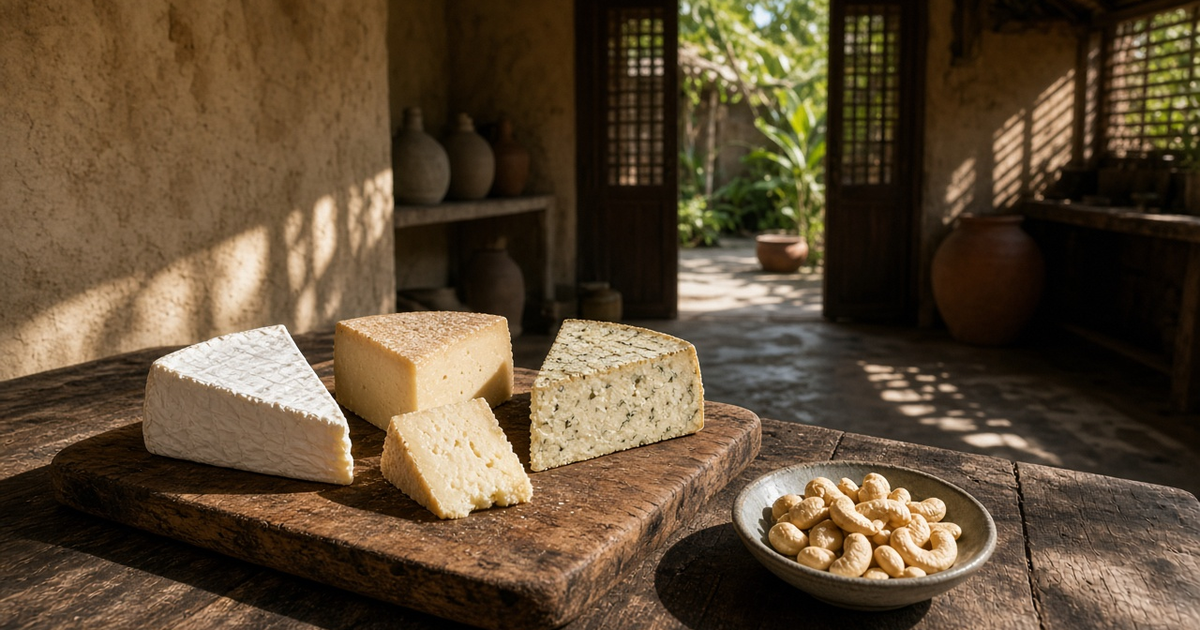
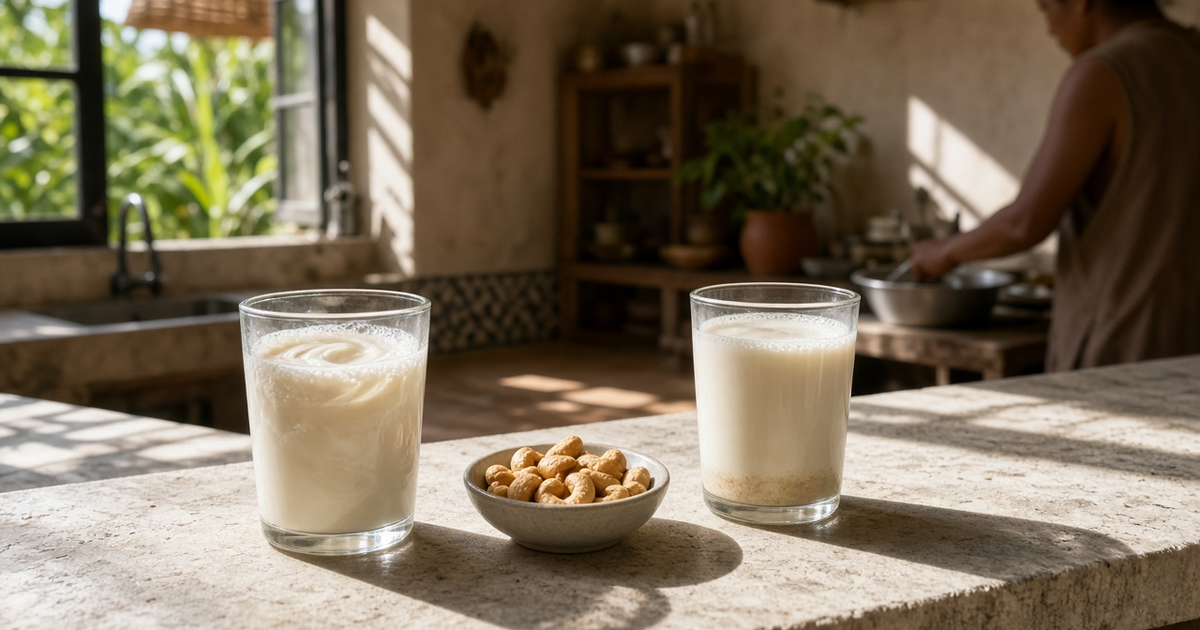
Cashews are high FODMAP at any realistic serving, carrying both GOS and fructans. Cashew milk is diluted, so the nut load per glass is small, and that is the whole basis for calling it low FODMAP. Monash has not published a general cashew milk entry, and dietitians split on the inference. Some treat a cup as fine because the nut load is low. Others point out that a richer recipe uses several times more cashews and can push the galactan load up.
The rule of thumb in circulation is fat content: 5 g of fat per serve or less is likely low FODMAP, above that likely not. A dietitian’s heuristic, not a lab measurement: a starting point for your own trial, not a verdict.
Worry Nut’s fresh cashew mylk carries 6 g of total fat per 200 ml serving, measured by Prodia OHI. By that heuristic it sits on the wrong side of the line, and pretending otherwise would make the rest of this article worthless. If you are in the elimination phase of a low FODMAP diet, a cashew base is the one to test last and smallest, whatever the brand.
Gums are not FODMAPs
Search “plant milk IBS” and half the results warn about gums. That warning is a different question from FODMAPs.
Xanthan, gellan, locust bean, guar and carrageenan are polysaccharides used to thicken water and stop solids settling. They are not on the Monash FODMAP lists as fermentable carbohydrates, and a carton can be low FODMAP while carrying gellan. What people report is a different signal: bloating after gums, repeated often enough in low FODMAP communities to be worth knowing. Controlled research on that is thin, and the mechanism is not the FODMAP pathway.
So a gum-free label is not a low FODMAP label, and a low FODMAP carton is not automatically gum-free. If you react to one and not the other, you have learned something no serving table will tell you.
The decision
Choose a tested carton if:
- You are in elimination: you want a base with a published serve size
- You need shelf life: the carton sits in a cupboard, or you are stocking a rental with unreliable cold storage
- You want fortification: added calcium and vitamin D are the trade you are accepting
- You drink soy: find a carton built on soy protein rather than whole beans
- You want a fixed product: the same carton every week while you work out your triggers
Choose a fresh bottle if:
- You have finished elimination: you are testing foods one at a time
- You want a short list: six lines you can explain beat twelve you cannot
- You are in Bali or Jabodetabek: a cold chain can actually reach you
- You finish it fast: the bottle is gone within four days of opening
- You control the pour: you would rather set the serve size than trust a panel
Neither column is medically correct. The carton wins on tested serve sizes and shelf life, the fresh bottle on list length and on pouring your own serve.
A fresh cashew bottle, read honestly
Worry Nut is a fresh cashew mylk made in small batches in Ubud, Bali. The recipe is six lines: filtered water, Indonesian cashews, Central Java coconut sugar, Kusamba sea salt, sunflower lecithin, and Bali vanilla. No gums, no refined seed oils, no artificial preservatives.
It is pasteurised with gentle heat rather than UHT treated, which is why it lives in a fridge and not on a shelf. The cashews are milled fine enough to hold the liquid in suspension without a gum. The coconut sugar is there for roundness, not for a health story, and it is still sugar.
Per 200 ml serving, measured by Prodia OHI: 80 kcal, 6 g total fat, 5 g carbohydrate, 2 g sugar, 150 mg sodium, 2 g protein.
Cashew milk is not a nutritional substitute for cow’s milk. Worry Nut carries 2 g of protein per 200 ml serving against roughly 8 g in cow’s milk, and it is not fortified with calcium or vitamin D. If you are relying on milk for those nutrients, plan for them elsewhere.
That disclosure is why this article can be trusted on a condition-specific question. A product that admits its own protein gap and its own uncertain FODMAP position is one you can compare honestly.
Delivery runs chilled across Bali, covering Denpasar, Badung and Gianyar, and through a stockist network in Jabodetabek. Bali orders go through the order page, with same-day delivery before 14:50 WITA. Jabodetabek orders go straight to the stockist.
If you are still working out whether dairy is your trigger, the guide to dairy allergy versus lactose intolerance separates two things that get confused constantly, and the symptom checklist is the practical companion. The Bali shortlist covers local formats. For the label mechanics behind the three lines above, the ingredient label walkthrough goes line by line, and the NOVA test explains what processing does and does not tell you.