Clean Label, Explained for Shoppers in Indonesia
You pick up a bottle at Indomaret or a Bali health shop, turn it around, and read eleven ingredients. Half of them you cannot pronounce. The front of the pack says “natural” and the back says “emulsifier (471)”. Nobody is lying to you exactly, but the two sides of that bottle are not answering the same question.
“Clean label” is the shorthand people use when they want the back of the pack to match the front. It has no legal definition, no certifying body and no minimum standard. That is the honest starting point, and it is also why the term gets abused so freely.
What clean label actually means
In practice, clean label describes a direction rather than a status: shorter ingredient lists, recognisable names, fewer industrial additives, and a front-of-pack claim that survives comparison with the back. A product can move toward that idea without arriving.
The term entered food marketing in the 2000s, when manufacturers stripped out preservatives and artificial colours and needed a way to say so. Retailers then formalised it differently from each other, some by banning additive lists from own-brand lines and others by printing a logo. None of those standards agree, which is why two “clean label” seals from two companies tell you nothing comparable.
This article is general information, not medical advice. If you have a diagnosed condition, are pregnant, or are changing a child’s diet, talk to your doctor or a dietitian first.
That gap matters commercially. A brand can print “clean” on the front while using a thickener on the back, because no regulator will object. The useful skill is therefore not memorising seals, it is reading the ingredient list faster and more sceptically than the marketing department writes it.
The four tests, in the order that saves you the most time
Run them in this order. Most products fail at test one, which means you never need to do the maths on the nutrition panel.
- Count the ingredients. Under ten is a useful rule of thumb, under six is genuinely short.
- Picture each one. If you cannot see the food in your head, the name is a category, not an ingredient.
- Look for a bracket. Anything in brackets is a sub-list, and sub-lists hide things.
- Check the front against the back. Any claim on the front must be provable from the back.
None of these tests require a nutrition degree. All four together take about ten seconds once you have done it a few times.
Test 1: count the ingredients
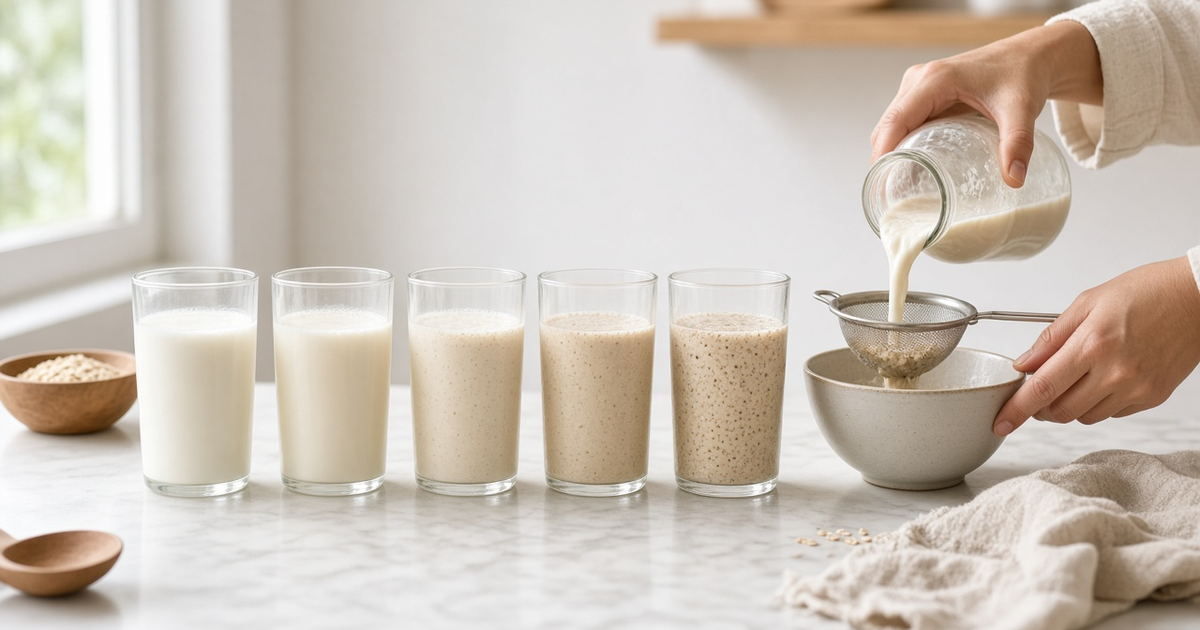
Ingredient lists are ordered by weight, so the first three items tell you what you are mostly buying. A plant milk that leads with water and then almonds is mostly water, which is normal and fine. A “cashew” drink that leads with water, then sugar, then cashews is a sweetened water with a nut in it.
Length is a blunt instrument, and it is still the fastest signal available. Every additional ingredient exists to solve a manufacturing problem: separate, thicken, preserve, colour, fortify or extend shelf life. That does not make those ingredients dangerous, but it does tell you how far the product has travelled from the whole food it claims to be.
The counter-example is worth holding onto. A long list is not automatically worse than a short one, because a fortified product with twelve ingredients may deliver more nutrition than a clean six-ingredient one. Clean label and nutritious are different axes, and conflating them is the single most common mistake in this whole conversation.
Test 2: can you picture the ingredient
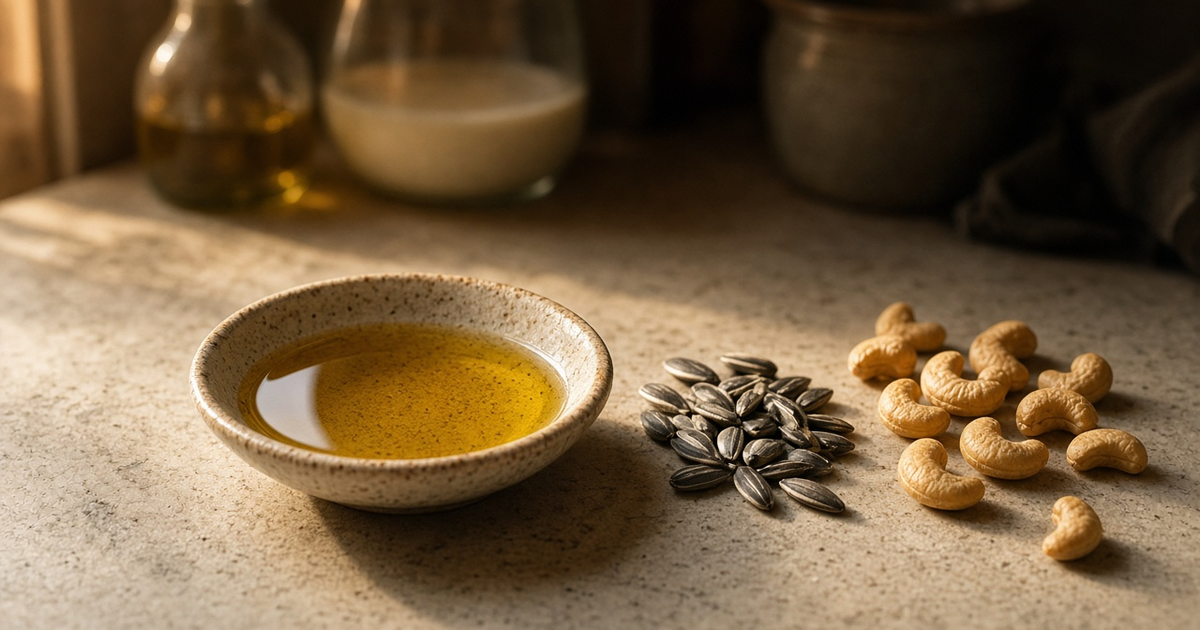
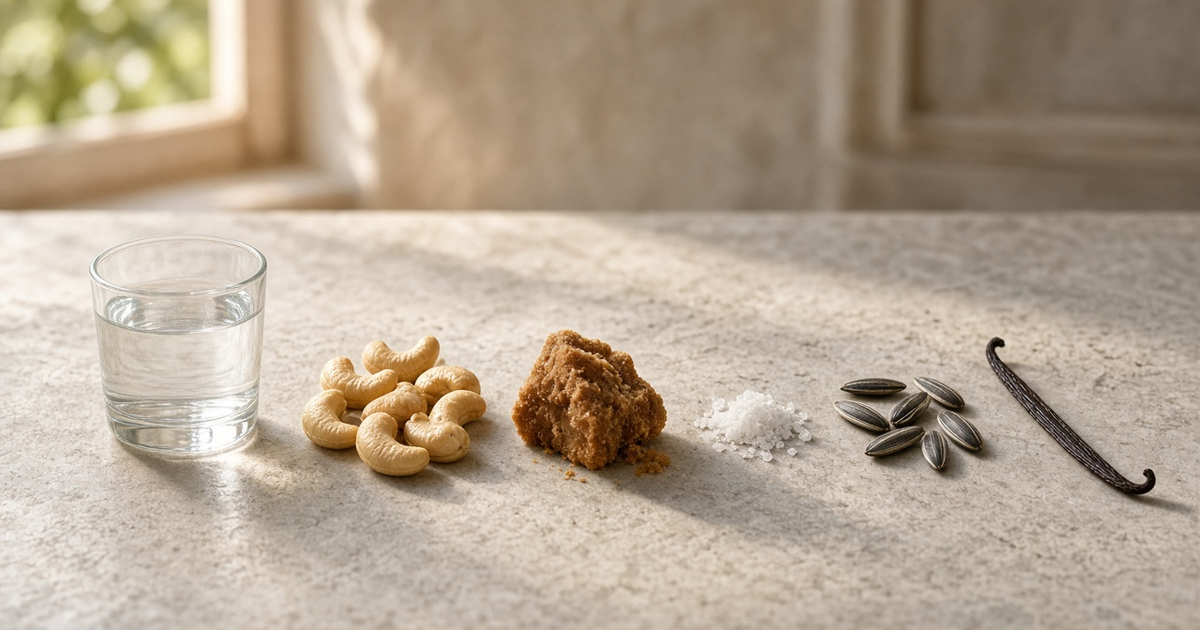
“This is the whole list, in plain English” is a claim you can actually verify, one line at a time. Filtered water, you can picture. Cashews, you can picture. Coconut sugar, sea salt and vanilla, yes. Sunflower lecithin is the interesting one, because most people cannot picture it, and the honest answer is that it is an emulsifier derived from sunflower seeds.
Compare that with a list that reads: stabiliser (407), emulsifier (322), acidity regulator (330), flavour. Each of those is a legal name for one specific substance, and the number in brackets is an international additive code that the European Food Safety Authority evaluates one at a time. It is technically more precise than a common name and completely useless in an aisle. It is also completely opaque to a shopper standing in a cold aisle with a phone in one hand.
Picture-ability is a proxy, not a proof. It catches the products that have been assembled rather than cooked, and that is usually enough.
Test 3: nothing hides behind a category name
Three phrasings do most of the hiding.
- “Flavouring” or “flavour”: a legal umbrella that can cover dozens of compounds. Natural and artificial versions are both allowed under it.
- “Vegetable oil”: usually palm, sometimes with a blend. The label does not have to say which, or in what proportion.
- “Stabiliser”, “emulsifier”, “thickener”: a functional category followed by a code. The code is specific, the category is not.
A label is genuinely clean when the em dash has nothing to do. If every line names a food and nothing needs a bracket, you have probably found a short recipe rather than a formulation.
Test 4: the front has to survive the back
This is where most “clean” claims die. A carton can say “no artificial preservatives” while containing a thickener, because a thickener is not a preservative, or say “dairy free” while carrying a refined oil. Each statement is literally true and the impression is false.
The fix is mechanical. Pick the biggest claim on the front, hunt for the ingredient that would make it misleading, and check whether the back addresses it. If the front says “no added sugar”, read the carbohydrate line. If it says “plant based”, check whether the fat comes from nuts or from an added oil.
| Front-of-pack claim | What it guarantees | What it does not |
|---|---|---|
| “No artificial preservatives” | No preservative class additive | Nothing about thickeners, gums or oils |
| “Natural” | Almost nothing legally | Anything about processing level |
| “No added sugar” | No sugar added as an ingredient | Nothing about naturally occurring sugar |
| “Plant based” | No animal-derived ingredients | Nothing about additive count |
| “Clean label” | Nothing enforceable | Anything at all, on its own |
That table is the reason this article exists. Four of those five claims are legally true and commercially misleading at the same time.
What clean label does not mean
It is not a synonym for healthy. A six-ingredient product can still be high in sugar, salt or saturated fat. Ingredient count says nothing about portion size, and portion size is where most nutrition arguments actually live.
It is not a synonym for organic. Organic is a certification with audited standards around how food is grown, while clean label only describes what is on the ingredient list. A product can be certified organic and carry four additives, or be uncertified and carry two ingredients.
Cashew milk is not a nutritional substitute for cow’s milk. Worry Nut carries 2 g of protein per 200 ml serving against roughly 8 g in cow’s milk, and it is not fortified with calcium or vitamin D. If you are relying on milk for those nutrients, plan for them elsewhere.
A quick list of what the term never guarantees:
- Low sugar: ingredient count says nothing about sweetness
- Low salt: same, and salt is often the fourth or fifth line
- Organic: a separate audited certification, not a label style
- Additive free: lecithin and citric acid are additives too
- Unprocessed: grinding nuts is processing, and so is pasteurising
- Healthier than the alternative: a different question entirely
It is also not a synonym for unprocessed. Grinding nuts into a liquid is processing, and so is pasteurising it, which is why the NOVA classification used by nutrition researchers separates processing level from ingredient count. The useful question is not “processed or not” but “how far, and why”, which is the difference between a kitchen and a factory.
Applying it in an Indonesian supermarket
The format you meet most often is the imported UHT carton, and it is built for a long sea freight and a warm shelf. That usually means a stabiliser, an oil, and a fortification pack. Reading those labels with the four tests will rule most of them out on test one, which is the correct outcome rather than a scandal.
Local fresh products are the opposite trade: shorter lists, shorter shelf life, and a cold chain you have to trust. The tests still apply, but the failure mode changes. On a fresh bottle the risk is not additive count, it is whether the cold chain held.
Choose the imported carton if:
- You need it to sit in a cupboard for months
- You are travelling or stocking a rental with an unreliable fridge
- You want added calcium and vitamin D, and the fortification is the point
Choose the fresh bottle if:
- You will finish it within four days of opening
- You have fridge space and a cold chain you can rely on
- You would rather have six recognisable ingredients than twelve functional ones
For the label mechanics themselves, the close-read guide to plant milk ingredients and the general ingredient label walkthrough go deeper than this article needs to. If you want the short version of what belongs in a plant milk and what does not, what is in your plant milk covers it in one pass.
A worked example on a real bottle
Worry Nut is a fresh cashew mylk made in Ubud, and it is a useful test case because the whole ingredient list fits in one sentence.
| Line | Ingredient | What it is doing |
|---|---|---|
| 1 | Filtered water | The base |
| 2 | Indonesian cashews | The nut the recipe is built around |
| 3 | Central Java coconut sugar | Sweetness |
| 4 | Kusamba sea salt | Flavour balance |
| 5 | Sunflower lecithin | Plant emulsifier, keeps the fat suspended |
| 6 | Bali vanilla | Flavour |
Six lines, one of which is an emulsifier, which is the honest weak point and worth naming rather than hiding. There is no gum, no refined seed oil, no preservative, and no flavouring umbrella. The nutrition panel is lab-measured by Prodia OHI at 80 kcal and 2 g sugar per 200 ml serving.
That is what a clean label looks like in practice: a short list where you can explain every line, plus a clear statement of what the product does not do.
Frequently asked questions
Is clean label regulated in Indonesia? No specific clean label standard exists. BPOM regulates labelling, additives and claims, and those rules are what a manufacturer is legally held to. “Clean label” itself is marketing language, which is why you have to read the list rather than the front.
Is a shorter ingredient list always better? No. A short list can still be unbalanced, and a longer list can be more nutritious if it is fortified. Length tells you how much manufacturing happened, not whether the result is good for you.
Does clean label mean no additives at all? Rarely. Lecithin, citric acid and ascorbic acid are additives by definition and appear in otherwise short recipes. The useful distinction is between an additive that has a job you can explain and a category name that hides several ingredients.
How do I check a “no preservatives” claim? Look at the shelf life. A product with no preservatives and a multi-month ambient shelf life is a contradiction worth questioning. A product with no preservatives and a 21-day chilled life is telling a consistent story.
If you want a bottle that passes all four tests and is made a few kilometres from where it is sold, Worry Nut makes fresh cashew mylk in Ubud and delivers it chilled across South Bali, with a stockist network covering Jabodetabek. Bali orders go through the order page, and same-day delivery applies before 14:50 WITA. Jabodetabek orders go straight to the stockist.